|
The Lark Ascending
Out of abyss emerges the matrix
Primordial egg of existence
Diaphanous womb of our universe
Permeated by luminous power of celestial origin
Tempest is released from its fetters
Instantaneous collisions of energy thunderclap in silence
Pristine semina of duality take their stance
Origin of diversity begins
Mirror of endless contemplation crystallizes
As the chrysalis manifests itself
An entity of reflection,
Of spiritual longing takes form
Olamic metamorphosis impels cyclical inertia
Causation begins
Entrails of the nucleus expand and
Break apart releasing the monad
The lark ascends
An ecstatic paean issues forth
Venerating innocence with increasing charm
As resonance illumines Lydian Measures
The lark sojourns
Till elixirs of lengthening vigilance overflow
Then resumes its journey
Curt Doll
(After the Musical Composition
by Ralph Vaughan Williams)
A Literary Analysis of The Lark Ascending Illustrated Poem
This experience is an invitation to embark on a spiritual journey of sight and sound exploring with reverent introspection within the deepest resources of your own inner being.
"Out of Abyss Emerges the Matrix" - The Lark Ascending Poem by Curt Doll
The line "Out of abyss emerges the matrix / Primordial egg of existence / Diaphanous womb of our universe / Permeated by luminous power of celestial origin" is the opening stanza of The Lark Ascending, an illustrated poem by artist Curtis R. Doll Jr.
Context and Source
Curt Doll created The Lark Ascending as a multi-page illustrated work inspired by his own spiritual journey within and Ralph Vaughan Williams' 1914 violin composition The Lark Ascending. The poem blends cosmic, spiritual, and artistic imagery, with each stanza evoking themes of creation, birth, transformation, contemplation, and ever deepening spiritual awareness. The opening lines quoted describe the primordial origin of the universe - a "matrix" and "egg" emerging from the abyss, permeated with celestial light - setting the stage for the rest of the poem's metaphysical narrative.
These lines evoke the ancient "cosmic egg" motif found in Hindu, Greek, Chinese, Finnish, and other creation myths, where the universe emerges from a primordial void and a radiant, enclosed womb of existence.
How the Imagery Connects to the Cosmic Egg Tradition.
The passage
"Out of abyss emerges the matrix / Primordial egg of existence / Diaphanous womb of our universe / Permeated by luminous power of celestial origin" - aligns closely with well documented cosmogonic egg myths:
1. Primordial Abyss (Void or Waters)
Many traditions begin with an undifferentiated void or cosmic waters:
Hindu Hiranyagarbha emerges from dark cosmic waters.
Orphic Greek myth describes a silver egg forming in the night void.
Finnish Kalevala begins with Ilmatar floating in primordial waters.
2. The Egg as Matrix of Existence
The egg symbolizes latent potential and the boundary between nonexistence and existence:
Hindu texts describe the golden cosmic egg as containing all matter, consciousness, and life.
Comparative mythology shows a shared pattern: chaos ? egg ? incubation ? hatching- formation of cosmic elements.
3. "Diaphanous Womb of the Universe"
This phrase mirrors descriptions of the egg as a luminous womb:
Hiranyagarbha literally means "Golden Womb," the radiant source of creation.
The cosmic egg often splits into heaven and earth, forming the structure of the universe.
4. Luminous Celestial Power
Light emerging from the egg is a recurring motif:
Phanes, born from the Orphic egg, is the deity of light and creation.
The golden radiance of Hiranyagarbha symbolizes divine energy and cosmic illumination.
Summary
These poetic lines reflect a universal mythological pattern: the universe emerging from a radiant, primordial egg that contains all potential existence. This imagery appears across cultures and symbolizes the transition from void to cosmos, from darkness to light, and from undifferentiated potential to structured reality.
Artistic and Poetic Meaning
In Doll's vision, the "primordial egg" is both a cosmic womb and a symbol of potentiality, from which diversity and consciousness arise. The "luminous power of celestial origin" suggests a divine cosmic force that animates this creation . The poem continues with imagery of the "tempest released," "collisions of energy," and "mirror of endless contemplation," moving toward the "lark ascending" - a metaphor for the soul's journey into spiritual awakening.
In short: The phrase quoted is the opening of Curt Doll's The Lark Ascending, a poetic and visual meditation on the birth of the universe, inspired by enlightened meditation and Vaughan Williams' music with Doll's rich cosmic, spiritual symbolism.
Literary Analysis of "Tempest is released from its fetters" in The Lark Ascending
The line "Tempest is released from its fetters" appears in The Lark Ascending by Curtis R. Doll Jr., an illustrated poem inspired by Ralph Vaughan Williams's violin piece The Lark Ascending. In this context, it is not a direct quotation from Shakespeare's The Tempest, but rather a poetic image drawn from the play's storm motif, reimagined in a metaphysical and spiritual register.
Literal and symbolic meaning
In Shakespeare's The Tempest, the "tempest" is both a literal storm that wrecks the ship and a metaphor for chaos, transformation, and the forces of nature. Doll's phrase "released from its fetters" suggests the storm breaking free from constraints - a moment of liberation, both physical and symbolic. This can be read as the unleashing of primal energy, the dissolution of absolute order, and the emergence of a new state of being.
Imagery and thematic resonance
The surrounding lines - "Instantaneous collisions of energy thunderclap in silence / Pristine semina of duality take their stance / Origin of diversity begins" - frame the tempest as a generative force. The "collisions of energy" evoke the creative moment of release; "pristine semina of duality" points to the birth of opposing forces (light/dark, order/chaos) that underpin diversity. This aligns with the play's broader themes of transformation, the interplay of magic and nature, and the emergence of new identities from chaos.
Instantaneous collisions of energy thunderclap in silence
This verse is a metaphor for the mystery of spiritual depth and power. In the spiritual realm, the irony is, things aren't what they seem. Deeper meaning requires of necessity intense contemplation.
The one and only addition-revision to the poem in fifty years
For five decades, both the poem and its visual compositions have undergone continuous revision. A recent and only addition to the text introduces the phrase "in silence" immediately following the line, Instantaneous collisions of energy thunderclap. While the musical score lacks a crescendo powerful enough to mirror a literal thunderclap, this omission actually deepens the poem's emotional weight. It underpins the spiritually serene essence in the profound creative act of love. Ultimately, the juxtaposition introduces a compelling sense of mystery-a "happy accident" I first discovered at The York Academy of Arts and one that continues to bring me immense joy to this day.
When Instantaneous collisions of energy thunderclap in silence- the entire universe is in a state of absolute, undeniable ecstatic bliss. The most precious gift a couple can give one another is to simply "be" with one another in perfect silence, isolated from all the meaningless noise of the world and just "be" in each other's presence in mutual, communal, reciprocal contented happiness. They gift each other with this sacred moment of absolute, contented, ecstatic bliss. That is as close to unconditional agape love as humans (apart from the mystics) will ever receive. It is an epitome of human love verging on the divine.
Connection to The Tempest
Shakespeare's tempest is the catalyst for the play's events - it disperses the shipwrecked characters, enabling the island's drama and the resolution of conflicts. In Doll's poem, the tempest's release is not destructive but generative, mirroring the play's idea that the storm, while disruptive, is also the source of renewal and, in Doll's vision, the "origin of diversity."
Literary devices
Metaphor
The tempest as a liberating force, not just weather, encompassing the loving performance of renewal.
Personification
The tempest "released" from fetters, giving it agency.
Symbolism
The storm as a creative, transformative agent, echoing the play's magical and natural forces.
Allusion
Implicit reference to Shakespeare's The Tempest without direct quotation, inviting readers to bridge the two works."
Interpretive takeaway
In this poem, the "tempest" is a mythic image of change - the breaking free of constraints, the collision of forces, and the birth of multiplicity. It reframes Shakespeare's storm as a spiritual and artistic event, where chaos becomes the seed of diversity, and the "release" is both an act of destruction and creation. This reading invites the reader to see The Tempest not only as a play about a storm, but as a meditation on the creative power of disruption.
"Mirror of Endless Contemplation" in The Lark Ascending
The line "Mirror of endless contemplation crystallizes / As the chrysalis manifests itself / An entity of reflection, / Of spiritual longing takes form" is part of The Lark Ascending, an illustrated poem by Curtis R. Doll Jr.
Context within the poem
The Lark Ascending is a multi-section, illustrated poem that blends the music of Vaughan William's The Lark Ascending musical composition, cosmic imagery, spiritual symbolism, and the visual art of fine painting, aiming to reveal the interconnectedness of music, ballet, poetry, and visual art. Ballet is later silently implied by the motion in the fifth and seventh stanzas of the poem.
The "Mirror of endless contemplation" stanza appears in the middle of the poem, between the "Origin of diversity begins" and "Olamic metamorphosis" sections. It follows the "primordial egg" and "tempest" imagery, and precedes the "lark ascends" passage. In this sequence, the "mirror" symbolizes a reflective, contemplative state - a moment of stillness and self awareness - while the "chrysalis" represents transformation and the emergence of a new, spiritual form.
Artistic and thematic meaning
The idea for The Lark Ascending and its creation came together almost instantly over fifty years ago. However, the imagery associated with the poem has been evolving over the past fifty years, from 1976 to 2026. The initial studies featured abstract, linear representations of The Lark, which were part of a structure resembling a matrix breaking apart. These early images were quite simplistic, and naïve. It wasn't until twenty-three years later, in 1999, after graduating from computer art school, that the first tangible and somewhat successful images emerged. The image representing The Tempest took several years to finalize. The image for The Lark Ascending appeared quite spontaneously, occurring in one of my sketchbooks. I appreciated its stylized elegance and revisited it for several years without knowing how to proceed until I started using a computer. Eventually, I scanned it and incorporated it into my digital painting of The Lark Ascending. Over the next thirty years, I worked on revising it intermittently until this past summer of 2026, when I believe I finished it. The Diaphanous Womb was the first image completed within a year, and subsequent images followed in order, with two setbacks along the way. As of this year, 2026, the project is complete.
The inspiration for The Lark Ascending came while listening to Vaughan Williams's The Lark Ascending after returning from a Spiritual Retreat where I engaged in intensive meditation along with intermittent studies of mysticism. During one meditation, I experienced a profound moment of enlightenment. The Lark Ascending embodies both the insights I gleaned from that experience and my deep desire to relive that ecstatic, blissful state. Additionally, this poem aims to evoke the "spiritual depth" of Vaughan Williams's music while also seeking to illuminate the interconnectedness of various art forms: music, poetry, dance, and visual art.
The "mirror" and "chrysalis" imagery suggest -
Reflection and introspection - the "mirror" as a metaphor for the self examining mind.
Transformation - the "chrysalis" as the process of becoming, aligning with the poem's broader theme of cosmic and inner evolution.
Spiritual longing - the "entity of reflection" as a state of being that embodies yearning for the divine transcendent."
In short: This line is a poetic and visual metaphor for the moment when inner reflection crystallizes into a tangible, spiritual form - a central image in Doll's The Lark Ascending that ties together cosmic creation, personal transformation, and the longing for the sacred.
Literary Analysis of "Olamic Metamorphosis Impels Cyclical Inertia / Causation Begins"
Before we go on, a quick note on aesthetics and structure of the paintings:
The Golden Ratio or Golden Section or Golden Rectangle was considered by ancient Greek Architects, mathematicians and philosophers alike to be the ideal proportion echoing the divine. It was used in the Parthenon and it was used in this painting, "Olamic Metamorphosis" along with the Logarithmic Spiral symbolizing The Divine Act of Creation and the spiraling on of cyclical inertia embodying spiritual life.
They along with every other image in these 7 paintings are contained within an oval format in order to maintain and re-emphasize the opening image - "Out of abyss emerges the matrix / Primordial egg of existence / Diaphanous womb of our universe".
A golden rectangle's proportions are "short side : long side" = 1 : 1.618, and the whole rectangle's length is also 1.618 times its height. This constant ratio is what makes it "golden."
I began with a square, then added Φ (phi) - 1.618 to it, then added another square equal to that proportion and continued adding squares in ever growing proportions along the same spiraling path so I could later attach a logarithmic spiral to the growing structure theoretically continually expanding on into infinity.
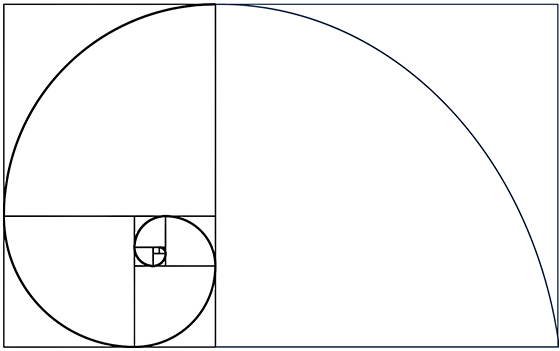
Φ (phi) is actually 1.618033988749894… - an irrational, non-repeating decimal. 1.618 is a rounded off number for convenience. The number actually goes on (so far as we know) to infinity, never stopping. The Logarithmic Spiral, also based on Φ (phi) is seen through out nature. The instances are virtually endless from seashells to the growth of plants, and there are countless more examples.
The Golden Rectangle symbolizes divine, aesthetically perfect, harmonious structured proportion along with the Logarithmic Spiral symbolizing both cyclical inertia and eternal spiritual progression-evolution substantiating The Larks Continuing Flight on to ever increasing spiritual awakening.
In Curtis R. Doll Jr.'s The Lark Ascending illustrated poem, the line "Olamic metamorphosis impels cyclical inertia / Causation begins" functions as a philosophical and symbolic pivot point in the work's cosmogonic narrative.
Context within the poem
The poem unfolds as a mythic creation sequence: it begins with the "abyss" and the "primordial egg" (a diaphanous womb of the universe), moves through the release of a tempest, the collision of energies, and the emergence of duality. The "mirror of endless contemplation" and "chrysalis" suggest transformation and reflection, leading to the moment of "Olamic metamorphosis". This is the point where the cosmic process shifts from potentiality to active becoming.
Meaning of "Olamic metamorphosis"
The term "Olamic" here is a neologism or stylized form of "universal" or "cosmic," evoking the olam (world) in Hebrew or the cosmos in Greek. "Metamorphosis" signals a profound transformation - in this case, the transition from a static, potential state to a dynamic, evolving reality. It is the moment of creative change, where the primordial conditions reconfigure into a new order.
"Impels cyclical inertia"
"Cyclical inertia" suggests a self-perpetuating motion or rhythm - a recurring pattern of change and stability. The "impels" (drives, propels) indicates that the metamorphosis is the force that sets this cycle in motion. In philosophical terms, it is the engine of ongoing transformation, where each cycle contains the seeds of the next.
"Cyclical inertia" - a perpetual enigmatic phenomenon
Human creative processes involve spurts of inspired motion. Then one comes up against a roadblock where ideas cease to flow and everything stops. For the fortunate, this process continues on in cycles. Creative flow-inertia-creative flow-inertia. It is the bane of a creatives existence. However, this adds excitement to the living process of the creatives spirit. The relieved recognition that one continues to experience the joy of a continued, meaningful life.
"Causation begins"
This is the explicit claim of genesis: the moment when cause and effect enter the narrative. In the poem's logic, before this line, the universe is in a state of potential; after it, the process of creation and change is in motion. It marks the transition from mythic potential to actualized process.
Symbolic and thematic significance
Cosmogony
The line encapsulates the birth of the creative process, aligning with the poem's earlier imagery of the "primordial egg" and "tempest."
Cyclical time
It suggests that creation is not a one-time event but an ongoing, repeating cycle of transformation.
Philosophical causality
By stating "causation begins," Doll embeds a metaphysical claim - that the universe's order is rooted in an initiating cause, which then perpetuates itself through cycles.
Artistic integration
This line is part of a larger intertextual work blending poetry, visual art, music, and ballet (inspired by Vaughan Williams' The Lark Ascending), reinforcing the idea of art as a medium for expressing cosmic and spiritual processes.
Interpretive reading
In literary terms, this line is both a narrative turning point and a philosophical statement. It condenses the poem's mythic creation sequence into a single, dense image: the moment when the cosmic transformation (metamorphosis) sets in motion the perpetual cycle of change (cyclical inertia) and the very principle of cause and effect (causation). It invites the reader to see the poem not just as a lyrical meditation, but as a structured cosmological allegory.
In summary
The phrase is the poem's "creative ignition" - the moment where mythic potential becomes active, cyclical, and causal, embodying the intersection of art, philosophy, and cosmology in Doll's work.
Literary Analysis of "Entrails of the Nucleus Expand and Break Apart Releasing the Monad" in The Lark Ascending
In Curt Doll's illustrated poem The Lark Ascending, the line "Entrails of the nucleus expand and Break apart releasing the monad" appears in a sequence of cosmic, spiritual, and symbolic imagery. To analyze it, we must situate it within the poem's broader structure and the artist's stated intent.
Context within the poem
The poem opens with cosmogonic images - "Out of abyss emerges the matrix," "Primordial egg of existence," "Diaphanous womb of our universe" - evoking creation and the birth of the cosmos. The "nucleus" here is not merely a physical atomic core but a metaphysical center of being, a concentrated source of potential. Its "entrails" suggest the innermost essence, the substance of that center. The "expansion" and "breaking apart" describe a rupture and dissolution of that concentrated state, releasing the "monad" - a term drawn from Hermetic and Neoplatonic thought, meaning a single, indivisible unit of reality or spirit.
Symbolic meaning
This moment marks a transition from potentiality to manifestation. The "monad" is the seed of individuality - consciousness - divine spark. Its release from the nucleus's interior mirrors the creative act: the collapse of a unified, undifferentiated state into a multiplicity of forms. In the poem's arc, this is followed by "The lark ascends," linking the cosmic event to a bird's upward flight - a traditional symbol of spiritual ascent, transcendence, and the soul's journey toward the divine.
Thematic resonance
Doll's own commentary notes that The Lark Ascending blends music, poetry, ballet, and visual art to reveal "the interconnectedness between the arts" and to evoke "a deeper longing for the discovery of one's own inner being". The nucleus's rupture thus functions as both a cosmological and personal metaphor: the inner self must "break apart" from its dense, unified state to allow the spiritual essence (the monad) to emerge and rise - an experiential discernment of meditation.
Stylistic features
The line's syntax is compressed and rhythmic, with the break between "expand and" and "Break apart" creating a caesura that mimics the moment of cosmic release. The diction ("entrails," "nucleus," "monad") is dense and esoteric, inviting the reader into a layered symbolic register. This aligns with the poem's overall style - a fusion of scientific imagery, mystical terminology, and lyrical abstraction.
Interpretive synthesis -
Literally, the image evokes nuclear fission; metaphorically, it depicts the dissolution of a unified, latent state into a multiplicity of conscious possibilities. In the poem's spiritual trajectory, it is the pivotal moment where the cosmic and the personal intersect: the "monad" released is both the origin of diversity and the seed of the soul's ascent, setting the stage for the lark's journey toward light and transcendence.
A literary analysis of the passage where "The lark ascends" within Curt Doll's The Lark Ascending Illustrated Poem reveals a highly structured, multi-disciplinary work. While traditionally rooted in George Meredith's 1881 pastoral verse, Doll's illustrated framework expands the text into a cosmic and deeply spiritual journey.
The specific sequence where "The lark ascends" serves as the structural and thematic climax of the poem, building upon an elaborate symbolic progression.
1. Structural Progression and Context
The passage does not exist in isolation; it functions as a spiritual awakening that resolves a sequence of intense cosmic events. The narrative trajectory operates in distinct thematic movements:
The Primordial Commencement:
The poem opens with a "primordial egg", serving as a cosmic womb that represents pure, undifferentiated potential and the origin of diversity.
The Chaotic Catalyst:
This state of potentiality fractures into a "tempest released" characterized by "collisions of energy".
The Reflective Chrysalis:
Before the ascension, the narrative moves through a "mirror of endless contemplation". This critical phase represents a moment of absolute stillness, self-awareness, and transformative hibernation.
The Celestial Transmutation: Emerging from this reflective chrysalis, the lark finally ascends. The transition moves the poem decisively from darkness to light and from void to an organized, conscious cosmos.
2. Core Themes & Metaphors
The Soul's Metamorphosis:
The ascension of the lark acts as an allegory for the soul's journey into spiritual awakening. The bird's flight represents a shedding of earthly chaos (the "tempest") and the constraints of the physical form (the "chrysalis") to achieve higher consciousness.
Divine Animation:
The text utilizes imagery of a "luminous power of celestial origin". This implies that the lark's ascent is not merely an act of physical flight, but an response to a divine, cosmic force animating the universe.
The Synthesis of Motion (Implicit Ballet):
Doll's framework structurally links the text to physical grace. The motion inherent in the lark's upward flight directly mirrors the choreography of ballet. This transforms the written word into a vehicle for kinetic, visual grace.
3. Interdisciplinary Interconnectedness
Doll's broader artistic objective with the illustrated poem is to demonstrate how different creative mediums dissolve into one another. In this specific passage, three distinct artistic traditions converge:
Medium: Role in "The Lark Ascends" Passage
Literature Provides the foundational vocabulary of cosmic creation, mirroring, and ultimate spiritual flight.
Visual Art Fine painting anchors the abstract cosmic concepts, giving form to the unseen forces of the void and the light.
Music & Dance Evokes Ralph Vaughan Williams' famous musical interpretation, while the pacing of the stanzas captures the fluid mechanics of ballet.
Ultimately, the ascension of the lark in this illustrated work symbolizes a triumph over chaos. It marks the exact moment where raw, colliding energy stabilizes into structured reality, light, and elevated spiritual awareness.
In sum, this line is a concentrated metaphor for creation and self-realization - the breaking of the inner core to free the singular essence that can then rise, mirroring the poem's central theme of spiritual elevation through cosmic and personal transformation.
These lines come from Curt Doll's poem The Lark Ascending, a poetic interpretation of Ralph Vaughan Williams's 1914 violin composition, expressing spiritual uplift, purity, and musical radiance.
Explanation
The passage quoted- "The Lark Ascends" —
"An ecstatic paean issues forth
Venerating innocence with increasing charm
As resonance illumines Lydian Measures"-
appears in multiple published versions of Curt Doll's poem The Lark Ascending, which was written as a companion to Vaughan Williams's celebrated pastoral violin work.
Line-by-line meaning
"An ecstatic paean issues forth"
A joyful, exalted song or expression rises-reflecting the violin's soaring melodic line.
"Venerating innocence with increasing charm"
The music (and the lark's symbolic ascent) honors purity, simplicity, and natural beauty, growing ever more enchanting.
"As resonance illumines Lydian Measures"
The Lydian mode-characterized by its raised fourth scale degree-creates a bright, luminous musical quality. The poem highlights how the resonance of the violin illuminates these Lydian harmonies, echoing the composition's ethereal tonal atmosphere.
Context
Curt Doll's poem is intended to bridge poetry, music, ballet, and visual art, accompanying his illustrated fine art paintings inspired by The Lark Ascending. The poem has been published in art portfolios, exhibitions, and anthologies.
The quoted lines therefore represent a poetic evocation of musical transcendence, celebrating innocence and radiance through the metaphor of the ascending lark and the luminous Lydian mode.
Literary Analysis of "An ecstatic paean issues forth" in The Lark Ascending
The lines in question - "An ecstatic paean issues forth / Venerating innocence with increasing charm / As resonance illumines Lydian Measures" - are the sixth stanza of Curtis R. Doll Jr.'s illustrated poem The Lark Ascending, inspired by Ralph Vaughan Williams's 1914 violin concerto.
Context and source
This particular stanza in Doll's poem is a lyrical, mystical re-imagining of Vaughan Williams's pastoral, spiritual music. The "lark" symbolizes a spiritual - creative ascent, and the stanza marks a moment of heightened beauty and harmony in that journey.
Close reading
"An ecstatic paean issues forth"
A paean is a hymn or ode of praise; "ecstatic" suggests overwhelming joyful transcendence. Here, the "paean" is the lark's song, emerging as a celebration of existence.
"Venerating innocence with increasing charm"
The lark's song honors purity ("innocence") and enhances it with "increasing charm," implying a deepening aesthetic and moral appeal. This evokes the idea of beauty growing as it is acknowledged and cherished.
"As resonance illumines Lydian Measures"
"Resonance" is both literal (sound) and metaphorical (emotional and spiritual vibration). The Lydian mode is a musical scale associated with lightness, openness, and serenity. "Illuminates" suggests that this harmony brightens as it reveals the essence of the Lydian Measures - the musical and symbolic framework of the poem's vision.
Imagery and symbolism
The stanza blends musical imagery (paean, resonance, Lydian Measures) with spiritual imagery (innocence, illumination). The "Lydian Measures" can be read as the harmonic structure of the poem's world, and as the "measures" of life's rhythm, which the lark's song illuminates. This aligns with the poem's broader theme of cosmic creation and inner spiritual longing.
Tone and effect
The tone is reverent, celebratory, and ethereal. The diction ("ecstatic," "venerating," "illumines") elevates the moment to a sacred aesthetic, inviting the reader to experience the lark's song not just as sound, but as a unifying, transcendent force of love.
Interpretive significance
Within The Lark Ascending, this stanza marks the lark's "ascent" into a realm where music, nature, and spirituality merge. It reflects an aim of the poem: to translate the "spirit" of Vaughan Williams's music into a visual poetic experience, where the lark's song is both a celebration of innocence and a revelation of the harmonious order of the universe.
From a deeper understanding, The Lark was an outgrowth from a period of time I spent at a spiritual retreat practicing intense meditation with intervals of mystical study. The Lark Ascending is a result of a profound, unifying experience I had during meditation. The Lark Ascending represents my own inner yearning to revisit that profound ecstatic experience during meditation—bliss.
In sum, these lines are a poetic distillation of beauty, harmony, and spiritual elevation, using musical and natural imagery to convey the lark's ecstatic praise of purity and the illuminating power of art.
Literary Analysis of "The lark sojourns / Till elixirs of lengthening vigilance overflow / Then resumes its journey"
These final three lines close Curt Doll's illustrated poem The Lark Ascending, which was inspired by illuminating experiences during meditation and Ralph Vaughan Williams's 1914 violin piece and by extension, George Meredith's 1881 poem as Curtis only recently became aware of Meredith's poem and that it indeed inspired Vaughan Williams violin masterpiece. The stanza functions as a lyrical resolution, blending the imagery of the lark's flight with metaphors of spiritual and temporal experience.
1. Context within the poem
The poem builds through cosmic and mystical imagery - "primordial egg," "tempest," "mirror of endless contemplation" - before the lark's ascent becomes an "ecstatic paean". The closing lines shift from the cosmic to the personal, framing the lark's flight as both a literal journey and a symbolic state of heightened spiritual awareness.
2. Key imagery and symbolism
"The lark sojourns"
Sojourns suggests a temporary stay, a pause in the lark's flight, implying a moment of reflection and rest. This aligns with the pastoral, meditative tone of Vaughan Williams's music, where the lark's song is both a natural event and a spiritual metaphor.
"Till elixirs of lengthening vigilance overflow"
Elixirs here are not physical potions but metaphorical essences: the "lengthening vigilance" is the deepening awareness, attentiveness, and spiritual enlightenment that the lark experiences. The "overflow" conveys abundance and saturation, as if this heightened state is beyond containment.
"Then resumes its journey"
This closure returns to motion, suggesting cyclical renewal. The lark's journey is not ended but continues, implying that the experience of vigilance and inspiration is part of an ongoing process.
3. Tone and thematic resonance
The lines carry a meditative, almost liturgical tone, echoing the "Romance" subtitle Vaughan Williams gave his work. They merge the natural world (the lark's flight) with the inner life (vigilance, spiritual longing), a theme central to Meredith's original poem and to Doll's own intent to "reveal the interconnectedness between the arts" and to suggest our deepest desire - to discover ones own innermost being. The "overflow" of vigilance can be read as the culmination of the poem's earlier cosmic and mystical imagery, now distilled into a personal, emotional moment.
4. Stylistic features
Meter and rhythm
The lines follow a loose, flowing rhythm that mirrors the lark's song, the swelling of Vaughan Williams's violin line, but most significantly, my profound illuminating experience of enlightenment during meditation.
Diction
Words like sojourns, elixirs, and vigilance are elevated and evocative, creating a sense of timeless, sacred experience.
Structure
The progression from pause (sojourns) to abundance (overflow) to continuation (resumes) forms a small narrative arc - rest, fullness, movement - that mirrors the poem's overall arc from cosmic origin to spiritual ascent.
5. Interpretive significance
In this closing stanza, the lark becomes both a natural symbol and a spiritual agent. The "sojourn" is not idle rest but a moment of deepened perception, the "overflow" is the fruit of that perception, and the "resumed journey" is the integration of that experience into the ongoing flow of life. This aligns with the poem's broader theme: the lark's flight as a metaphor for the soul's journey toward self-discovery and renewal.
In summation, these lines are a poetic distillation of the poem's central metaphor - the lark's song as a bridge between the natural and the spiritual - and they close the work with a sense of cyclical, sustaining inspiration.
Composed by Ralph (Rafe) Vaughan Williams in 1914 and orchestrated following the First World War in 1920, The Lark Ascending is a pastoral romance for solo violin inspired by George Meredith's poem. While it is widely celebrated as an evocative portrait of pre-war English countryside, listening to it alongside the deeper spiritual undertones of his symphonic works suggests something more intimate. To me, the soaring violin does not just mirror a bird or a lost era; along with the substance of the composition, it captures a profound spiritual yearning to discover one's own inner being.
The one and only addition-revision to the poem in fifty years -
Once again, for five decades, both the poem and its visual compositions have undergone continuous revision. A recent and only addition to the text introduces the phrase "in silence" immediately following the line, Instantaneous collisions of energy thunderclap. While the musical score lacks a crescendo powerful enough to mirror a literal thunderclap, this omission actually deepens the poem's emotional weight. It underpins the spiritually serene essence in the profound creative act of love. Ultimately, the juxtaposition introduces a compelling sense of mystery-a "happy accident" I first discovered at The York Academy of Arts and one that continues to bring me immense joy to this day.
When Instantaneous collisions of energy thunderclap in silence- the entire universe is in a state of absolute, undeniable ecstatic bliss. The most precious gift a couple can give one another is to simply "be" with one another in perfect silence, isolated from all the meaningless noise of the world and just "be" in each other's presence in mutual, communal, reciprocal contented happiness. Sharing absolute, uninterrupted silence is the ultimate vulnerability—and the ultimate sanctuary. When two people can sit together without the need to fill the air with words, entertainment, or distractions, they strip away the performance of daily life.
It is a profound form of intimacy because it requires complete trust; you are allowing yourself to be seen entirely as you are, in your stillness. This alignment transitions love from something conditional (based on actions, words, or utility) to something essential (based purely on existence). It is a rare gift to find someone with whom silence is not awkward or heavy, but light, expansive, and entirely full. That is as close to unconditional agape love as humans (apart from the mystics) will ever receive. It is an epitome of human love verging on the divine.
In its purest form, in its very essence, that is what this poem and its accompanying paintings are all about,,, love. They collectively are about a celebration of light beauty and love. Love is beauty, and beauty is love. They coexist metaphysically to the extent that one cannot be distinguished from the other. Enter in light and all three combine into a wholly trinity. In the beginning there was light. The creative spirit is in essence love, beauty and light. The power of love is omnipotent. This is an eternal truth. Love, beauty and light are inextricably connected and self-contained. They are as eternal as the breath of Creation itself. We recognize ourselves and each other in them. And love is the center and the all powerful creative force manifesting everything.
As an 1977 Fine Art graduate of the York Academy of Arts, I have spent my life immersed in classical music, ballet, art, and literature. This act of love, inspired by Rafe Vaughan Williams' sublime violin composition, The Lark Ascending, seeks to reveal the interconnectedness between music, ballet, poetry, and fine art. On a deeper level, its intent is to impart the profound spiritual yearning to discover one's own inner being we all secretly aspire to; and in so doing,... we find love.
a love letter
|
The Lark Ascending
a love letter
Return to the Poem
|